





What Is a Silver IRA and How Does It Work?
A silver IRA is a self-directed IRA (SDIRA) that holds IRS-approved physical silver bullion under IRC §408(m), offering the same tax advantages as a traditional or Roth IRA. Unlike a conventional brokerage IRA limited to stocks, bonds, and mutual funds, a silver IRA uses a specialized custodian to purchase, title, and store physical silver on behalf of the account holder.
The legal foundation is IRC §408(m), which carves out an exception to the general rule prohibiting collectibles in IRAs—provided the silver meets a .999 fineness minimum and is held by an IRS-approved trustee or custodian. IRS Publication 590-A and IRS Publication 590-B govern contribution rules and distribution rules, respectively.
How a Silver IRA Works Operationally
- Custodian: A regulated trustee (bank, trust company, or IRS-approved non-bank custodian) holds legal title to the silver and files IRS Form 5498 annually to report the account's fair market value.
- Depository: An IRS-approved depository—Delaware Depository, Brinks, or International Depository Services (IDS) Group—stores your physical silver in a secure vault. Personal possession of IRA-owned silver is a prohibited transaction under IRC §4975 and triggers immediate taxation plus a 10% early distribution penalty.
- Pricing: Your custodian purchases silver at the spot price plus a premium over spot—typically $2–$5/oz for silver bars and $4–$8/oz for American Silver Eagle coins. The bid-ask spread and buyback program terms determine your true round-trip cost.
- Industrial silver demand: Silver's dual role as a monetary metal and an industrial input—accounting for approximately 55% of annual silver supply consumption—creates price drivers distinct from gold, which sees only ~8% industrial use.
The silver IRA actively diversifies a retirement portfolio by providing exposure to a tangible asset whose price is influenced by both precious-metals sentiment and industrial demand from sectors including solar panels, semiconductors, and medical devices.
Reviewed by the editorial team. We compare silver IRA companies using public information and our own evaluation criteria. Methodology: rankings weight (40%) verified BBB/CFPB complaints, (25%) fee transparency audited against 2026 fee schedules, (20%) buyback spreads, (15%) depository partner ratings. Sources: IRS Pub 590-A, 590-B; IRC §408(m), §4975; Silver Institute World Silver Survey 2026; U.S. Mint 2026 Bullion Report. Last updated: October 2026.
IRS Rules for Buying Silver in an IRA
The IRS requires all silver held in an IRA to be .999 fine or greater, stored in an IRS-approved depository—personal possession is a prohibited transaction under IRC §4975. Violating this rule causes the entire IRA balance to be treated as a taxable distribution in the year of the violation.
Fineness and Product Standards
Under IRC §408(m)(3), silver held in an IRA must meet at least a .999 purity standard. Sovereign mints—the U.S. Mint, Royal Canadian Mint, Perth Mint—produce the IRA-eligible bullion coins; NYMEX- and COMEX-approved refiners produce the eligible bars. LBMA Good Delivery bars meeting .999 fineness are also accepted by most custodians. The CFTC regulates commodity exchanges where silver futures are priced, providing the benchmark spot price used in IRA transactions. Note: Rev. Rul. 2014-54 (clarifying rollover rules) and IRS Form 1099-R (distribution reporting) govern the tax reporting side of silver IRA transactions.
What Is Excluded
- Proof coins: Collector-grade proof versions of otherwise eligible coins (e.g., proof American Silver Eagles) are generally ineligible because their value derives partly from numismatic premium.
- Numismatic coins: Pre-1933 coins and other numismatic coins are explicitly excluded under IRC §408(m)(2).
- Junk silver: 90% silver U.S. coins (pre-1965 dimes, quarters, half-dollars) do not meet the .999 fineness threshold and are ineligible.
- Personal storage (“home storage IRA”): Marketed schemes claiming you can store IRA silver at home have been consistently rejected by IRS guidance and Tax Court rulings; they constitute prohibited transactions.
Prohibited Transactions and Disqualified Persons
Under IRC §4975, a prohibited transaction occurs when the IRA engages in a transaction with a disqualified person—defined to include the account owner, their spouse, lineal descendants, and any entity in which the account owner holds a 50%+ interest. Selling silver you personally own to your IRA, or buying IRA silver for personal use, are classic prohibited transactions. Penalties include disqualification of the entire IRA and excise taxes of 15%–100% on the transaction amount.
IRS Publication 590-A (contributions) and IRS Publication 590-B (distributions and RMDs) are the primary IRS guidance documents governing silver IRA operation. Beware of IRA LLC or checkbook IRA arrangements marketed for home silver storage—courts and the IRS have consistently treated these as prohibited transactions, resulting in full IRA disqualification. Distributions are reported on IRS Form 1099-R, and you must report them on your federal income tax return for the year of distribution.
How to Open a Silver IRA: Step-by-Step
Opening a silver IRA requires four steps: selecting a custodian, funding the account (contribution, transfer, or rollover), purchasing eligible silver, and arranging depository storage. The process typically takes 2–4 weeks from application to first metal purchase.
Step 1: Select an IRS-Approved Custodian
Not all IRA custodians permit alternative assets. You must use a self-directed IRA custodian specifically approved by the IRS to hold physical precious metals. Evaluate custodians on fee transparency, IRS compliance track record, product selection, BBB and TrustPilot ratings, minimum investment thresholds, and educational resources. A one-time account setup fee of $50–$100 is standard.
Step 2: Fund the Account
Three funding methods are available under IRS rules:
- Annual contribution: Subject to 2026 IRA contribution limits of $7,000/year ($8,000 if age 50+). Contributions can be pre-tax (traditional) or post-tax (Roth).
- IRA transfer: A direct custodian-to-custodian transfer from an existing IRA. Transfers are not subject to the 60-day rollover rule and have no annual limit. This is the lowest-risk method for moving existing IRA assets.
- IRA rollover: Funds distributed to you personally must be redeposited within 60 days (the 60-day rollover rule) to avoid taxation. Indirect 401(k) rollovers trigger mandatory 20% federal withholding.
Step 3: Purchase IRS-Eligible Silver
Once funded, your custodian executes a buy order at the current spot price plus premium over spot. A wire transfer fee ($25–$35) typically applies. The silver is shipped directly from the dealer to the depository—it never passes through your hands.
Step 4: Arrange Depository Storage
Choose between segregated storage (your specific coins or bars kept separate) or allocated storage (your silver pooled with other investors' holdings by type and weight). Segregated storage costs more but provides cleaner in-kind distribution at withdrawal. Annual storage fees range from $100–$150 for segregated, $75–$100 for allocated.
Silver IRA Eligible Products: Coins, Bars, and What's Excluded
IRS-approved silver products include American Silver Eagles, Canadian Maple Leafs, and .999+ bars from NYMEX/COMEX refiners; proof coins and numismatic coins are typically ineligible. Product eligibility is governed by IRC §408(m)(3) and does not change based on the dealer you use—the fineness and mint/refiner standards are fixed by statute.
IRS-Eligible Silver Coins
- American Silver Eagle (1 oz): Produced by the U.S. Mint; .999 fine silver; the only coin explicitly named in IRC §408(m)(3)(A)(i). Bullion versions are eligible; proof versions are generally ineligible.
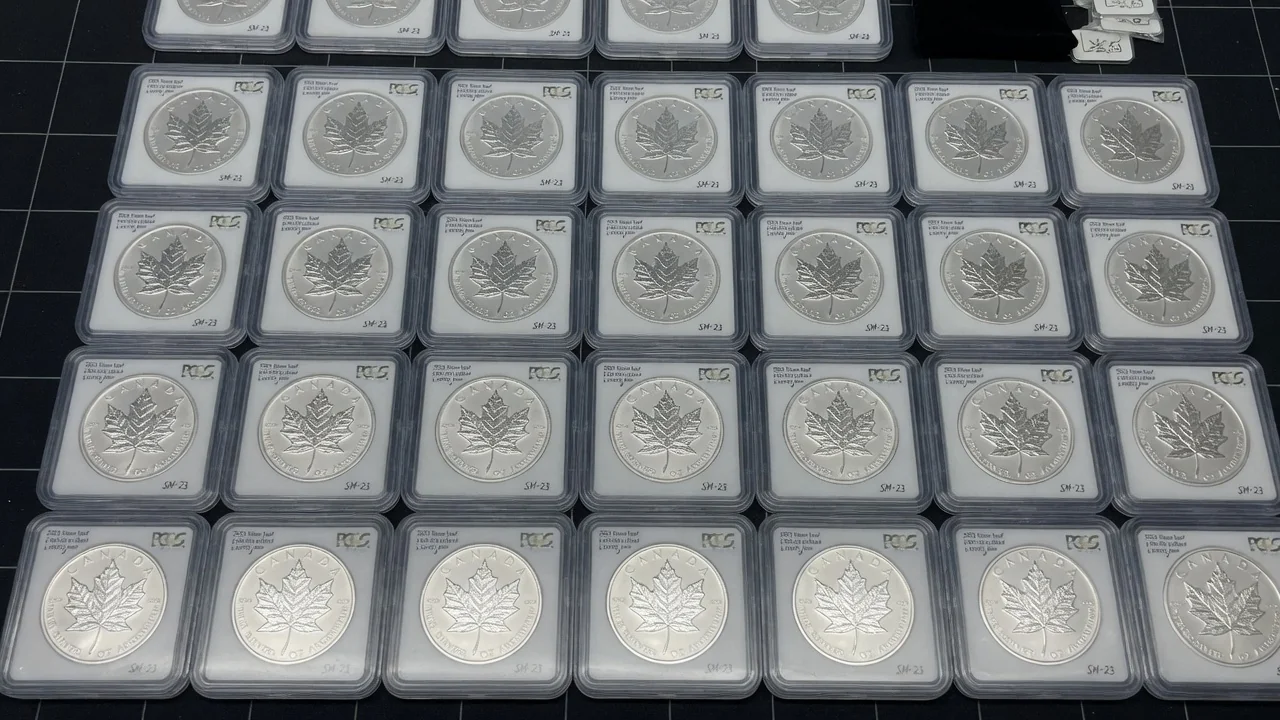
- Canadian Silver Maple Leaf (1 oz): .9999 fine; issued by the Royal Canadian Mint; meets IRS fineness requirements.
- Australian Silver Kangaroo / Kookaburra (1 oz): .9999 fine; issued by the Perth Mint under Australian government guarantee.
- Austrian Silver Philharmonic (1 oz): .999 fine; issued by the Austrian Mint.
- British Silver Britannia (1 oz): .999 fine; issued by the Royal Mint of the United Kingdom.
- Mexican Silver Libertad (1 oz): .999 fine; issued by the Casa de Moneda de México (Mexican Mint); eligible when meeting fineness and custodian acceptance criteria.
IRS-Eligible Silver Bars and Rounds
Silver bars must be produced by a NYMEX- or COMEX-approved refiner or assayer, meet the .999 minimum fineness standard, and carry the refiner's hallmark, weight, and purity stamp. Common eligible sizes: 1 oz, 5 oz, 10 oz, 100 oz. Reputable refiners include PAMP Suisse, Sunshine Minting, Johnson Matthey, and Engelhard. LBMA Good Delivery bars (.999+ fineness, minimum 750 troy oz) are accepted by most U.S. custodians for large-account storage.
Ineligible Silver Products
- Proof coins: Even proof American Silver Eagles are generally excluded because the numismatic premium makes them collectibles under IRC §408(m)(2).
- Numismatic coins: All pre-1933 silver dollars, trade dollars, and other coins valued above melt are ineligible.
- Junk silver: 90% silver U.S. coins (pre-1965 dimes, quarters, halves) fail the .999 fineness test.
- Silver certificates and ETFs: Paper instruments representing silver are not physical bullion and provide no IRC §408(m) benefit.
Always confirm eligibility with your custodian before purchase. Purchasing an ineligible item inside an IRA can constitute a prohibited transaction.
Silver IRA Fees: Setup, Custodian, and Storage Costs Explained
Total annual silver IRA fees range from $150–$300/year, comprising custodian fees ($75–$150), segregated storage fees ($100–$150), and one-time setup fees ($50–$100). Fee structures vary by custodian and should be evaluated on a total-cost basis over a 5–10 year holding horizon, not just the lowest headline rate.
Fee Breakdown by Category
- Account setup fee: One-time charge of $50–$100 to establish the SDIRA. Some custodians waive this for large initial deposits ($25,000+).
- Annual custodian fee: $75–$150/year for account administration, IRS Form 5498 filing, and regulatory compliance. Some custodians use flat fees; others use asset-based fees (0.25%–0.35% of AUM), which become expensive as balances grow.
- Segregated storage fee: $100–$150/year. Your specific silver is vaulted separately, tagged to your account, and returned to you in kind at distribution.
- Allocated (non-segregated) storage fee: $75–$100/year. Your silver is pooled with other investors' holdings by metal type and weight. Lower cost but less precise in-kind distribution.
- Wire transfer fee: $25–$35 per transaction for funding or distribution. Some custodians charge per-purchase transaction fees ($25–$50).
- Buyback program spread: When liquidating, custodians or affiliated dealers buy back silver at spot or slightly below spot. Evaluate buyback program terms—a narrow bid-ask spread saves significant money on exit.
How Fees Impact Long-Term Returns
On a $50,000 silver IRA, annual fees of $250/year represent a 0.50% annual drag on returns—before accounting for the bid-ask spread on purchases and the wire transfer fee at each transaction. Compare this to a silver ETF (e.g., SLV at 0.50% expense ratio) which has no storage or setup fees but provides no IRC §408(m) benefits and holds no physical silver directly in your name.
Red Flags in Fee Disclosure
Custodians that bundle fees into the silver purchase price (inflated premiums over spot) without disclosing them separately are a compliance concern. IRS Publication 590-A requires transparent fee disclosure. Prioritize custodians who publish a complete fee schedule before account opening.
Silver IRA Tax Rules: Contributions, RMDs, and Distributions
Silver IRA contribution limits mirror standard IRA limits ($7,000/year in 2026, $8,000 if age 50+); traditional silver IRAs require RMDs beginning at age 73, which may be fulfilled via in-kind silver distribution. Tax treatment depends on whether the account is structured as a traditional (pre-tax) or Roth (post-tax) IRA.
Contribution Rules (IRS Publication 590-A)
- 2026 contribution limit: $7,000/year for individuals under 50; $8,000/year for those 50 and older (catch-up contribution of $1,000).
- Income limits: Traditional IRA deductibility phases out at modified AGI of $79,000–$89,000 (single filers) and $126,000–$146,000 (married filing jointly) if covered by a workplace plan in 2026. Roth IRA contributions phase out at $150,000–$165,000 (single) and $236,000–$246,000 (married).
- Contributions are subject to the IRA contribution limits regardless of whether the IRA holds silver, stocks, or other assets.
Traditional Silver IRA: Tax Deferral and RMDs
Contributions to a traditional silver IRA may be tax-deductible. Growth is tax-deferred. Distributions are taxed as ordinary income. Under the SECURE 2.0 Act, required minimum distributions (RMDs) begin at age 73. The RMD amount is calculated by dividing the account's December 31 fair market value (as reported on IRS Form 5498) by the IRS Uniform Lifetime Table factor for your age.
RMDs from a silver IRA can be satisfied by an in-kind distribution—transferring physical silver coins or bars out of the depository directly to the account holder, valued at the spot price on the distribution date. This avoids forced liquidation but requires arranging physical delivery from the depository.
Roth Silver IRA: Tax-Free Growth
Roth silver IRA contributions are made with after-tax dollars. Qualified distributions (account held 5+ years, age 59½+) are completely tax-free, including appreciation in the silver's value. Roth IRAs are not subject to RMDs during the owner's lifetime under current law.
Early Withdrawal Penalty
Distributions before age 59½ are subject to a 10% early distribution penalty plus ordinary income tax (traditional) or a 10% penalty on earnings (Roth). Standard exceptions apply (disability, first-home purchase up to $10,000, etc.) per IRS Publication 590-B.
How to Roll Over a 401(k) or Existing IRA into a Silver IRA
A direct custodian-to-custodian transfer is the safest rollover method—it avoids the 60-day rollover rule and the mandatory 20% federal withholding that applies to indirect 401(k) rollovers. Understanding the distinction between an IRA transfer and an IRA rollover is critical to avoiding unintended tax events.
IRA Transfer vs. Rollover: Key Differences
- IRA transfer (trustee-to-trustee): Funds move directly between custodians. You never receive a check. Not subject to the 60-day rollover rule. No annual limit on the number of transfers. No withholding. This is the recommended method for moving an existing IRA into a silver IRA.
- IRA rollover (indirect): The distributing custodian issues a check to you. You have 60 days to deposit the full amount—including any withheld taxes—into the new IRA. IRA-to-IRA rollovers are limited to once per 12-month period per the IRS one-rollover-per-year rule (Revenue Ruling 2014-9).
- 401(k) rollover: Employer plans are not subject to the one-per-year rollover limit but impose mandatory 20% federal withholding on indirect rollovers. A direct rollover from a 401(k) to a silver IRA avoids withholding entirely.
Step-by-Step Rollover Process
- Open a new SDIRA with a silver-approved custodian and complete all account paperwork.
- Request a direct transfer or direct rollover from your current plan administrator or IRA custodian.
- Provide the new custodian's wiring instructions. Funds typically arrive within 3–7 business days via wire transfer (a wire transfer fee of $25–$35 may apply at the sending institution).
- Once funds are credited, direct your custodian to purchase IRS-eligible silver at the current spot price plus premium over spot.
- Confirm depository receipt and review IRS Form 5498 at year-end for accurate fair market value reporting.
Roth Conversion Option
A traditional 401(k) or traditional IRA can be rolled into a Roth silver IRA (a Roth conversion). The converted amount is included in gross income in the year of conversion. There is no income limit on Roth conversions, but the tax cost must be weighed against long-term tax-free growth benefits.
Silver IRA Pros and Cons
Silver IRAs offer inflation hedging, portfolio diversification, and tax deferral, but carry higher storage costs, wider bid-ask spreads, and greater price volatility than gold. A balanced assessment requires comparing silver's specific characteristics against both conventional IRA assets and gold IRAs.
Advantages of a Silver IRA
- Inflation hedge: Silver has historically preserved purchasing power during periods of monetary inflation. Unlike paper assets, physical silver cannot be diluted by central bank policy.
- Portfolio diversification: Silver's correlation to equities is low over long periods, providing genuine diversification benefit. During the 2008–2009 financial crisis, silver initially fell but recovered sharply, reaching $49/oz in April 2011.
- Industrial silver demand as a price floor: Approximately 55% of annual silver supply is consumed by industry (solar photovoltaics, electronics, medical applications), providing demand support independent of investment sentiment.
- Tax-advantaged growth: The same deferred-growth (traditional) or tax-free-growth (Roth) benefits that apply to conventional IRAs apply fully to silver IRAs under IRC §408(m).
- Tangible asset ownership: Physical silver in segregated storage is not a counterparty obligation—it cannot default, dilute, or go bankrupt.
Disadvantages of a Silver IRA
- Higher fees than paper assets: Annual custodian and storage fees ($150–$300) apply regardless of account size, creating a meaningful drag for smaller balances.
- Price volatility: Silver's price is more volatile than gold's; the silver-to-gold ratio has ranged from 30:1 to 120:1 over the past decade, reflecting silver's smaller market and greater speculative activity.
- Wide bid-ask spread: The premium over spot on purchase, combined with liquidation at or below spot via a buyback program, means a round-trip transaction typically costs 5–15% of silver's value.
- No yield: Physical silver generates no dividends, interest, or coupon. All return depends on price appreciation.
- RMD complexity: Required minimum distributions from a traditional silver IRA require either selling silver (triggering a taxable event) or arranging an in-kind distribution, which involves logistical coordination with the depository.
Notable Investor Perspectives on Silver
Warren Buffett (Berkshire Hathaway, 1997–1998): Berkshire disclosed purchasing approximately 129.7 million troy ounces of silver, citing supply-demand imbalance. Buffett subsequently exited the position; Berkshire today prefers productive assets over precious metals. Elon Musk (February 2021): Tweeted “Silver will fly” during the Reddit-driven silver squeeze; silver spiked ~10% in days. Neither endorsement constitutes a long-term investment recommendation, but both episodes illustrate silver’s sensitivity to retail sentiment and media coverage—distinct from gold’s steadier institutional-demand profile. Silver ETF (e.g., SLV) vs physical IRA silver: ETFs track spot but provide no IRC §408(m) tax benefits and no claim on physical metal.
Segregated vs. Allocated Silver IRA Storage
Segregated storage assigns specific silver bars or coins to your account; allocated storage pools your silver with other investors' holdings—segregated costs more but offers cleaner in-kind distribution at withdrawal. Both options satisfy the IRS requirement that IRA silver be held by an IRS-approved trustee or custodian; neither permits personal possession.
Segregated Storage
Under segregated storage, the depository identifies your exact coins or bars by serial number, weight, and type. Your holdings are physically separated from all other customers' silver. Benefits:
- Precise in-kind distribution: at withdrawal, you receive the exact coins or bars originally purchased.
- No counterparty commingling risk.
- Easier to verify holdings via independent audit.
Annual cost: typically $100–$150/year. Recommended for accounts over $50,000 and for investors who anticipate taking physical delivery at distribution.
Allocated (Non-Segregated) Storage
Under allocated storage, the depository holds your silver as a fungible claim on a specific weight and purity of silver—your ounces are commingled with other investors' silver of the same type. Your claim is fully backed (the depository holds enough physical silver to cover all allocated claims), but your specific bars are not earmarked. Benefits:
- Lower annual cost: typically $75–$100/year.
- Sufficient for most investors who plan to liquidate rather than take physical delivery.
Approved Depositories
IRS-approved depositories include the Delaware Depository (Wilmington, DE), Brinks Global Services, International Depository Services (IDS) Group (multiple locations), and the Texas Precious Metals Depository. Each carries insurance coverage (typically Lloyd's of London) and undergoes independent annual audits. The Perth Mint's custodial program is recognized by some U.S. custodians for international allocated storage, though verification of IRS approval status with your specific custodian is required.
Storage and IRS Form 5498
Your custodian reports the fair market value of all IRA-held silver to the IRS annually on IRS Form 5498, filed by May 31 of the following year. The valuation is typically based on the spot price on December 31 of the reporting year.
Top Silver IRA Companies Compared (2026)
Augusta Precious Metals, Goldco, and American Hartford Gold are the top-rated silver IRA custodians in 2026 based on fee transparency, product selection, and verified customer complaint ratios. Our editorial team evaluated each company across six weighted criteria.
Editorial Methodology
Reviews are conducted by the editorial team using the following six criteria:
- Fee transparency (25%): Full fee schedule disclosed before account opening, no hidden premiums over spot.
- IRS compliance (20%): Custodian's track record with prohibited transaction avoidance and accurate IRS Form 5498 filings.
- Product selection (20%): Range of IRS-eligible silver coins and bars; availability of American Silver Eagles, Canadian Maple Leafs, and NYMEX/COMEX-approved bars.
- BBB/TrustPilot ratings (15%): Verified customer reviews and complaint resolution ratios on BBB (Better Business Bureau) and TrustPilot.
- Minimum investment (10%): Lower minimums improve accessibility for smaller investors.
- Educational resources (10%): Quality of IRA guides, fee calculators, and IRS compliance information provided to prospective clients.
Top Silver IRA Companies
- Augusta Precious Metals: A+ BBB rating; transparent fee structure with no hidden buyback spread; dedicated one-on-one educational webinars. Minimum investment: $50,000. Known for strong IRS compliance documentation and Harvard-trained economics staff commentary.
- Goldco: A+ BBB rating; broad silver product selection including American Silver Eagles and Maple Leafs; competitive segregated storage fees; established buyback program. Minimum investment: $25,000.
- American Hartford Gold: A+ BBB rating; no setup fee for qualifying accounts; strong TrustPilot score (4.9/5 on 2,000+ reviews); flexible minimum investment ($10,000). IRS Form 5498 filed accurately and on schedule per client feedback.
Disclaimer
This comparison reflects publicly available information as of Q1 2026. Fees, minimums, and ratings are subject to change. This content is for educational purposes only and does not constitute personalized investment advice. Investing in a silver IRA involves market risk, including the potential loss of principal. Consult a licensed financial advisor and qualified tax professional before making retirement investment decisions. IRC §408(m) compliance requires working with an IRS-approved custodian; this site does not provide legal or tax advice.
Author: the editorial team. We compare silver IRA companies using public information and our own evaluation criteria. Sources: IRC §408(m), IRS Publication 590-A, IRS Publication 590-B, U.S. Mint product specifications, CFTC commodity standards.
Silver vs. Gold IRA: Which Is Right for You?
Silver's higher industrial demand (55% of annual supply vs. ~8% for gold) creates different price drivers; gold's lower volatility typically makes it the core precious metals holding, with silver as a satellite position. Choosing between a silver IRA and a gold IRA—or holding both—depends on your portfolio objectives, risk tolerance, and time horizon.
Key Differences Between Silver and Gold IRAs
- Industrial demand: Silver consumes approximately 55% of its annual supply in industrial applications (photovoltaics, electronics, medical). Gold's industrial use is ~8%. This means silver's price is more sensitive to global manufacturing cycles and the renewable energy buildout.
- Price volatility: Silver is historically 2–3x more volatile than gold, as measured by annualized standard deviation. The silver-to-gold ratio—which measures how many ounces of silver equal one ounce of gold—has ranged from approximately 30:1 to 120:1 since 2010, reflecting silver's larger price swings.
- Premium over spot: Silver's lower per-ounce price means storing an equivalent dollar value of silver requires more physical volume, increasing storage costs and, typically, the premium over spot paid on purchase.
- Bid-ask spread: Silver typically has a wider percentage bid-ask spread than gold, making silver more expensive to trade in and out of—a relevant consideration for investors who may need to liquidate to meet RMDs.
- IRS fineness standards: Gold IRA products require .995 fineness (IRC §408(m)(3)(B)); silver requires .999. Both are governed by the same prohibited transaction rules under IRC §4975.
Portfolio Allocation Framework
Most financial planners who recommend precious metals IRAs suggest a structure where gold serves as the primary precious metals position (stability, liquidity, lower storage cost per dollar) and silver serves as a satellite position (higher upside in bull markets, industrial demand exposure). A common allocation framework is 70–80% gold, 20–30% silver within the precious metals sleeve of a diversified retirement portfolio.
The Silver-to-Gold Ratio as a Decision Tool
Investors use the silver-to-gold ratio as a relative value indicator. When the ratio is historically elevated (e.g., above 80:1), silver is considered undervalued relative to gold. When the ratio is compressed (below 50:1), gold is relatively cheaper. This metric does not predict absolute price direction but informs allocation decisions within a precious metals IRA.